-
RESOURCES
-
GHG Local
Climate change mitigation involves actions to reduce greenhouse gases by source or enhance their removal or sequestration through sinks. In the Enhanced LGU Guidebooks (3 & 4) on the Formulation of Local Climate Change Action Plan (2017, DILG-LGA), local governments are encouraged to undertake low-emission development strategies (LEDS) to align and contribute to the national agenda of transitioning towards a low-carbon economy. The design and prioritization of LEDS are informed by the conduct of greenhouse gas inventory.
A greenhouse gas inventory is a summary of greenhouse gas accounting results which explains the scope for accounting. The GHG inventory shows the category of emission sources considered for community-level and entity-level computation, namely, stationary combustion, mobile combustion, purchased electricity, solid waste in landfills, wastewater treatment and discharge, agriculture (crops and livestock), industrial processes and products use (for select industries), and forestry. The GHG quantification sheet is a tool to aid in quantifying and managing data and information on the GHG emissions and removals of users for community-level, relevant to the Local Climate Change Action Plans, Comprehensive Development Plan, or the Comprehensive Land Use Plan. Along with it is a user manual to provide a step-by-step guide in developing their GHG inventory.
-
RESOURCES
-
GHGI Webinar for LGU
Background
The Climate Change Commission and the Department of the Interior Local Government – Local Government Academy jointly conducted a series of three-day webinar on conducting community-level greenhouse gas inventory throughout August 2021.
It aimed to build the knowledge and information of LGUs on formulating inventories that inform climate mitigation measures/strategies as a section in their Local Climate Change Action Plans.
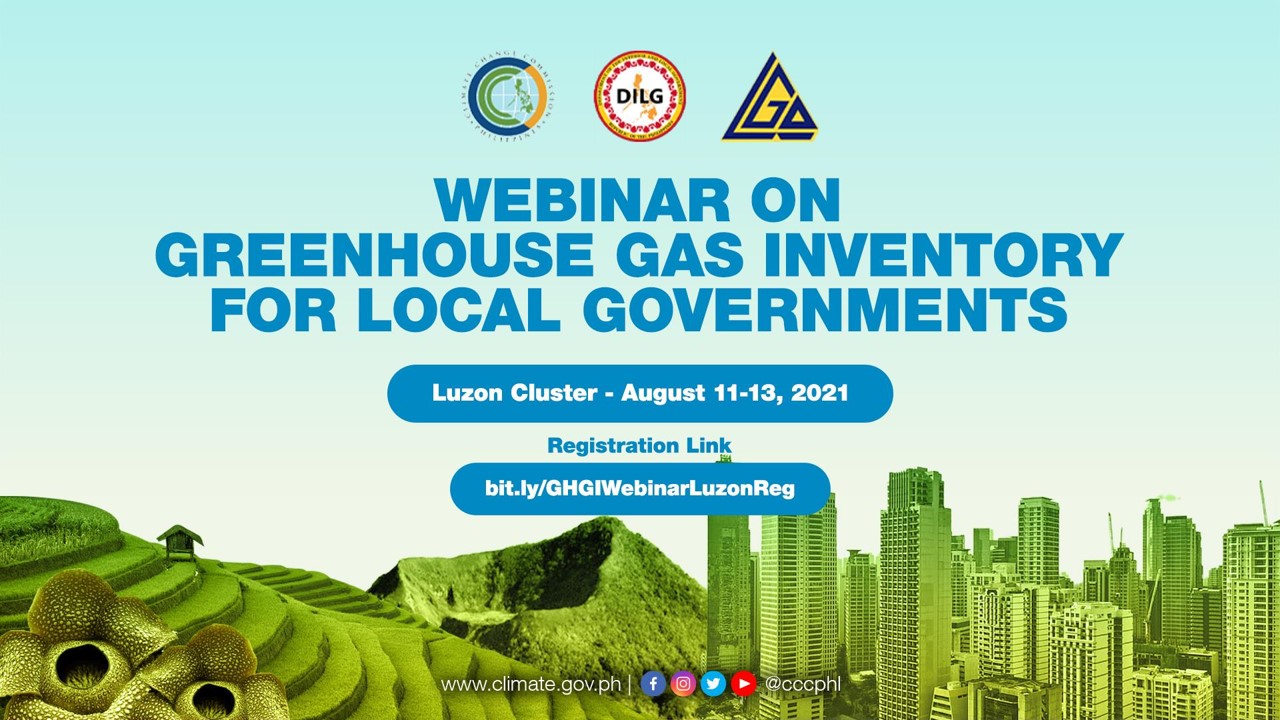
Webinar Modules
| Module | Resource Speaker |
| Climate Change in the Philippines and Importance of conducting GHG inventory by LGUs | CCC National Panel of Technical Experts |
| Linking climate change mitigation in local development planning | DILG-Bureau of Local Government Development |
| Local government experience in GHG inventory | LGUs Batangas City, Iloilo City, and Cagayan de Oro City |
| Introduction to GHG inventory | CCC |
| Energy and transport sector GHG emissions | |
| Agriculture sector GHG emissions | |
| Forestry and land use change sector GHG emissions | |
| Waste sector GHG emissions | |
| Industrial processes and product use sector GHG emissions | |
| Walkthrough of GHG Inventory Toolkit and Data Requirements |
Recording and Presentation Materials
| Luzon Cluster (11-13 Aug 2021) | http://bit.ly/GHGIMaterialsLuzon |
| Visayas Cluster (18-20 Aug 2021) | |
| Mindanao Cluster (22-27 Aug 2021) |